Invest in Peace launches four dimension approach

Essential to understanding investment is the concept of capital. One use of the term CAPITAL is a measure in monetary terms of the amount of money put into an organisation. To work with investing in peace, we prefer to use a wider definition of capital.

CAPITAL: Assets used – in the process of providing the conditions for peace – but not used up.

This leads to connections between the four dimension of peace – with myself, others, the Earth and in our structures.

Read more about the four dimensions via this link.

Peace with yourself

Human Capital

  • Peace Education
  • Non-violence


integral_cross

Peace with the Earth

Natural Capital

Built Capital

  • Land restoration
  • Circular economy
  • Holistic management
  • Renewable energy
  • Permaculture
  • Transition
  • Eco-villages

Peace with each other

Social Capital

  • Peace Culture
  • Non-violence
  • Performing arts
  • Social enterprise
  • Mutual Aid

Structures that support Peace

Financial and Social Capital

  • Treaties
  • Equality
  • Social security
  • Welfare society
  • Rules, regulations
  • Corporate law


Examples of the kinds of capital that need to be developed and used are illustrated in the diagram below.


FOUR CAPITAL TYPES

Canadian Office

_DSC3074We are pleased to announce our new volunteer in Canada. Doctor Shakeri Fard is based in Montreal. As a volunteer for Invest In Peace in the region she is interested in the broad issue of health and staying healthy. She is a Lecturer/researcher in microbiology/biotechnology with specialty in microbial assays, analytical methods and quality control. Apart from her wide teaching (water/food microbiology) and supervision experience, she has worked in industry in both Denmark and Iran, in process management Department and R&D for herbal medicines as chemist and R&D consultant, respectively.
Doctor Fard is especially interested in the health benefits of herbal medicines, the health aspects of water and food and using natural alternatives to chemicals in food (bio-preservative) and agriculture (bio-protection).
Contact the Canadian office via the Contact Page.

Environmental Fiscal Reform urgent if we are to build solid platform for peace

The topic of OECD policy discussions since the early 2000s,  EFR, Environmental Fiscal Reform – a shift in economic policies to incentivize businesses to stay within ecological boundaries – is even more valid today in 2017.

Recent events point to the urgent need for reform: carbon emissions are on the rise; pollution is the biggest killer, the Paris Agreement is far from within reach and the nitrogen cycle is so badly broken that accumulated nitrates in rock threaten water supplies and aquatic environments. A societal system that exposes its citizens to these threats undermines the security that is a foundation stone of a culture of peace. Continue reading Environmental Fiscal Reform urgent if we are to build solid platform for peace

Volunteer position – Peace Bank Co-ordinator –

Invest in Peace Volunteer position

– Peace Bank Co-ordinator –

OBJECTIVE To process peace bank entries, support members by assisting their application to the peace bank and arranging and running peace bank networking sessions. To facilitate funding applications from network members in consortium. A very rewarding role as you get to work with some of the leading peace organisations in the world.
WHAT CAN YOU DO? Details:

  • Help organisations join the peace bank
  • Running networking sessions
  • Updating web based databases containing information on partners
  • Communicating with peace Bank member representatives
  • Working on funding applications
  • Arranging webinars for members to publicize their organisation

You will work closely with co-founders in this position·

SKILLS AND EXPERIENCE NEEDED Comfortable in coordinating role, preferably experienced in using wordpress and CRM tools. Experience with applying for funding
RESOURCES REQUIRED Broadband, computer, Skype

English

Non- reimbursement of costs

Phone

WHERE CAN YOU DO IT? Most work is done from home

Regular meetings via Skype with team

WHO WILL YOU WORK CLOSELY WITH? Founders and core team as well as members’ representatives.
TIMELINES Approximately 4 to 7 hours per week.
DURATION ongoing
WHO TO CONTACT Stephen Hinton

stephen.j.hinton@gmail.com


Peace Promotor: Peas on Earth

OVERVIEW

Name: Peas on Earth http://peasonearth.se

Type: Peas on Earth is a business concept owned by Ecoetanol@Sweden AB

Mission Statement: To save our soils and environment and bring food security to places with degraded soils by offering sustainable fertilization, fuel and food technology

Peace-promoting activities: Regenerative Food and fuel security technology.


Continue reading Peace Promotor: Peas on Earth

Peace Promotor: the Institute for Economics and Peace

OVERVIEW

Name: Institute for Economics and Peace     http://visionofhumanity.orgInstitute for Peace-economicsLOGO

Type:  NGO, registered offices in Sydney, The Hague, New York, Mexico City
Mission Statement:
We aim to create a paradigm shift in the way the world thinks about peace. We use data-driven research to show that peace is a positive, tangible and achievable measure of human well-being and development.
Peace-promoting activities:
The Institute for Economics and Peace is the world’s leading think tank dedicated to developing metrics to analyse peace and to quantify its economic value. It does this by developing global and national indices, calculating the economic cost of violence, analysing country level risk and understanding positive peace.

Peace Bank Status:Registered, unverified. Learn more about status here

Continue reading Peace Promotor: the Institute for Economics and Peace

Putting Peace first and the Sustainable Development Goals

17_goals_peace

Most people may have heard of the Sustainable Development Goals. Agreed within the United Nations on September 25th 2015, countries adopted a set of goals to end poverty, protect the planet, and ensure prosperity for all as part of a new sustainable development agenda. Each goal has specific targets to be achieved over the next 15 years. The United Nations encourages everyone to do their part to reach the goals: governments, the private sector and civil society.

Invest in Peace believes Goal 16 is the most important to focus on.

Without peace there can be no development, and without development, there is unlikely to be peace. Each of the 16 other Goals can contribute to peace as in turn peace contributes towards prosperity.

According to the Institute for Economics and Peace:

High levels of violence impact economic development by reducing foreign direct investment and broader macroeconomics such as interest rates and national productivity.

This directly affects poverty, life expectancy and educational outcomes, as well as indicators that are essential for long term development, such as infant mortality and access to services. Goal 16 measures everyday interpersonal violence, which affects all 163 countries through detrimental social and economic impact.

The conflict trap 

Nations affected by armed conflict suffer what’s known as a ‘conflict trap’. This occurs when the impact of conflict further increases the risk factors associated with conflict. For example, low socio-economic development can support conditions that create violence, but it is also a consequence of violence.

Countries with weak institutions are more vulnerable to conflict, as they do not have an effective means for conflict resolution. In 2016, global losses from conflict were estimated to be $14.3 trillion (PPP).

As the diagram at the top illustrates, there are 16 dimensions requiring urgent analysis – between the goal of peace and the other 16 goals. Each of these dimensions could potentially be influenced by economic factors which in turn can come from reforming the economic system through the implementation of stabilizing factors such as dividend-bearing climate fees.

The economic system should be treated as a system. Systems can be designed and run to perform to requirements. An economic system with various control points and feedback loops can serve humanity by ensuring that the better challenges are solved, the better it pays everyone in the system.

We believe we should explore  how financial incentives can be implemented to create societies where it pays to fulfill the global goals and build peace. In other words, we are calling for a system upgrade, where it pays all actors better in the economic system to act responsibly, fairly and sustainably.

The model requires the economic system to be completely aligned with, and serve, human values and needs. Fortunately, advances in engineering using digital systems to control performance, and the spreading digital economy, allow this next leap to happen. Breakthrough developments in Market-Based Instruments that work as actuators in complex systems, relying on information and feedbacks to citizens, like Climate Dividends, provide the potential for completely new approaches to governance through financial steering.

The Sustainable Development Goals, with peace as the main focus, will provide good guidance for how to set such a system up.

The relative cost of a plate of food: a wake-up call for economists?

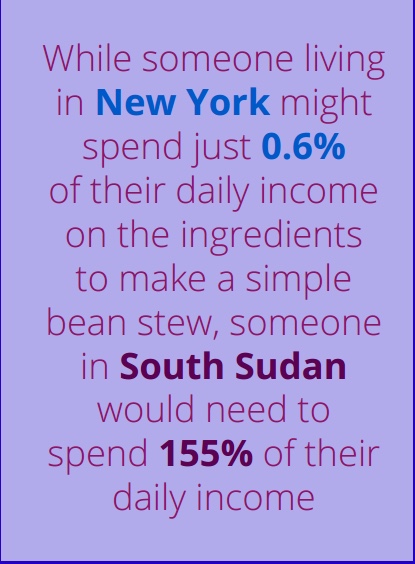
Beancost_exampleResearch reveals that the poorest are paying more they earn in a day for a single meal. This stark inequality is driving the global hunger crisis and weakening the foundations of peace in the world. 

Reported in the Guardian, a World Food Programme study reveals that the same bean stew can cost the average consumer in New York just $1.20, while the price tag is more than $320 in South Sudan. These figures come from calculating relative purchasing power – food prices against average wage. Continue reading The relative cost of a plate of food: a wake-up call for economists?

On where change will come to solve our most pressing problems

“Having spent my life as an activist within a civil society organisation, working both in UN corridors and in collaboration with social movements on the ground, I am firmly convinced that substantial change and real solutions to our most pressing problems – food, fuel and climate – will not originate from governments (or from UN agencies), but from civil society/social movements. Institutions will never move far enough or fast enough without the political pressure from demands by peoples and social movements.”

Mooney, P. (2012). Civil society strategies and the Stockholm syndrome. In Hällström, Niclas (ed.), What Next Volume III: Climate, Development and Equity. The Dag Hammarskjöld Foundation, p.327.

Thanks to Daniel Pergman for finding the quote.

Opinion: peace does not need more energy; capitalism does

Stephen Hinton 2016, photo Maj-Lis Koivisto

Most of the energy used in the world economy comes from non-renewable sources. Analysts fear that the expanding extraction of energy will not keep up with the expanding economy and …well… the economy will deflate like a balloon and everyone will be worse off. Worst for the poor who have very little already. Or they fear that the climate will collapse because we are pouring too much carbon dioxide into it just to stay alive. Either way, the economy is so dependent on energy, they say, that we will go into a period of recessions and undermine peace is many ways. Not strictly true in my opinion that there is too little energy: there is enough energy to keep everyone fed and housed within planetary boundaries. It’s just that there is not enough to keep capitalism going. And it is the failings of capitalism that we need to address if we are to make this peace project real, not energy supplies. Continue reading Opinion: peace does not need more energy; capitalism does